A Southward Tide

Poems, essays and excerpts. A favorite quote or two. An observation. A compendium of imagery. A dream analysis.

Tag: Arts

Labyrinthine Way

I must have had a thousand feet to walk
your hollow lanes, like licks of fire that stalk
the harvest hay. Through your maze I beat wings
like moth to the flame. City of past things
too narrow to name, city of avenues
too wide to cross, city of endless queues:
I left your ant farm with its bird’s eye view.
I left the old block. I long walked my due.
Streets swept anew past the seconds I fled
cause time swallows fast, fresh feet tread my stead.
Farewell far city of brick memory,
my soles still imprinted with your fiery
mark. Upon cobbled stone, I’ll rest my feet
and watch as the masses flock to the heat.
Now in vaulted hall I stake the last stay –
lead others down your labyrinthine way.

Friendships of a Different Kind

The first days of college were a period of great possibility. We had finally arrived, survivors of parental dysfunction, high school theatrics and the ragged adolescent investigation into selfhood and drugs.

From across the country we had travelled, all different colors and sizes and textures, drawn together like pilgrims at the pinnacle of a spiritual quest. The University of Chicago. Within the fifteen block perimeter of this cathedral campus were stone dormitories, eating halls suffused with that particular Aramark smell, a classics building and humanities library, a radio station with a beaten up couch, an underground maze of corridors and basements – clandestine repositories of erudition – an old lap pool with its hexagonal tiles, muddy lawns under blooming canopies, snow drifts and icicles in winter, mosquitos and humidity. We congregated at the overheated student center, in beer bars with black painted floors, and on the back stairs of student apartments with their crusted windows and clanging radiators.

We trudged through the four years, forming friendships unlike any others we had known before or would know after. As teenagers, arriving fresh from the nest, we imprinted to each other like baby birds. Except we did not know that then. We could not possibly realize how unique college would be in the course of our lives.

And four years seemed like forever. But then it all came to an end, tapering off ever so slowly. Senior year. Countdown to commencement. Some of us were voracious planners – interviewing, assessing, paving small pathways toward a larger goal. Some of us just waited, a light anxiety fluttering in our hearts. We were beginning to disconnect from each other, to draw inwards. Some of us left our significant others and bade farewell to the minor friendships.

First we graduated. Then came September 11 and afterwards, our twenties continued for one long decade. We struggled through the process of maturation as we disassembled the staggering passions of youth.

Some of us walked this pain together, moving to New York or San Francisco or London or China, choosing similar careers and exploring fresh avenues together, reformulating and reinventing our friendships, strengthening them with each passing of the year.

Some of us died young.

Some of us drifted apart never to rekindle our former bond. We had each mapped a different route to cope with this thing called life, which in no way resembled what we thought life would be when we were eighteen years old and shimmering with the thrill of beginnings.

Maybe for some, our twenties buckled to cynicism as we realized that reality could not be manipulated like a teenager who constructs his own universe. But certainly and hopefully, some of us realized that within this staunchness of life was a different kind of joy. Now some of us marry. Now we have little children too. Some of us settle down to career. Some divorce. We stand at the dawn of another great era, another realm of simmering promise, albeit different in kind.
On Jadedness and Magic

I began feeling jaded during teenage hood. As the magic of childhood faded and life started to appear in all its glory, a wretched unjust affair, I experienced the common symptoms: eye-rolling, sarcasm, over-sensitivity, unfounded hatred of existing power structures, a thirst for independence occurring alongside a pathological desire to feel part of a group (my peers – unfortunately also teenagers). Then freedom! Graduation! And all sorts of new things started pouring in again. College. Undesirable behaviors. After experiencing everything there was to experience in a short span, and then moving to New York, activity and boredom capital of the world, now I was jaded again. My twenties were a decade of ugly shiftless feelings, disappointments and ebbing wonderment.

Much has already been said about my generation’s inability to grow up. We have squeezed the last drops of collegiate experience well into our thirties to thirsty, spiritually bereft results. We wait till almost middle age to have children. And to what end? Now a mother of two, I understand that psychic reconciliation with one’s own mother and father can only occur after a few years of interrupted sleep, bathroom floods and crayoned walls. How can we forgive the twisting directions of our own lives if we cannot understand our own incapacity as parents to shield a child from the arrows of existence? Since we cannot forgive, we cannot move on. We remain stunted teens with crow’s feet and graying hair.  

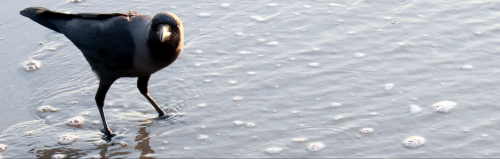
But more importantly, we remain jaded. I’m not suggesting that everyone needs children to perceive magic again. For others, a dog (or three) will suffice. Maybe a pet armadillo. A backyard teepee. Or a scuba tank and a fish-eye lens. But let’s just say: the magic has always been here. We just closed our eyes. And jadedness is this willing escape from the whole picture of life into the comfortable womb of resentment. It is a momentary death as we turn from brilliance to count circles on the ceiling.

Maybe the only way out is not through but on top of – flip it, turn it backwards, throw your life on its head. A call to all fellow werewolves, midnight flutists, bird whisperers and underwater stargazers (you know who you are) –  to paraquote Ghandi – be the magic you want to see in the world.

My Mother is an Extinct Bird

My mother is an extinct bird
sketched in children’s books,
surviving in imaginations
grand and small.

The old mantelpiece man
narrates this flight of auburn fiction,
his pipe alit by the tale’s wind.

How can I follow her
when she is a vellum-bound kite,
tracing pinpoint crescents across the sky?

A French Summer

The plane landed at Roissy onto a tarmac that mirrored the drab June sky. Always the day of her arrival was unseasonable weather. The French shook their heads and said the same thing “Ah! Ce temps.”  55 degrees and overcast with a ninety percent chance of rain, a hundred percent chance of gray. Summer by no standard.

France was its most insufferably French during the first hours spent escaping Charles de Gaulle airport: the interminable wait for the bags, the queue of dusty taxis to ship her off on highways flanked by concrete bunkers and sloppy graffiti. The scenic roads of France. Supermarkets housed in lego-blocks with chipper names like Conforama and Bricolorama, factories resembling Ikea versions of corrugated tin shanties, barely alive plants peaking above plastic coverings.  Further inland they drove, past the white-tiled tunnels with their overhead yellow-lit rectangles, past the wastelands of suburban brick flickering offside the highway barriers like images from a moving train. Resting her head against the taxi window, listening to the haggle on the radio, she felt acute disappointment. 

And the countryside did not seem quite right either. It was more crooked and wobbly than she remembered. They passed cigarette-stained towns with peeling shutters and windowsill doilies, old ladies in black orthopedics and knee-length skirts, mending handkerchiefs and knitting stiff wool. France had let weeds grow along her roads, in her gardens, up her trellis; the bristly stalks of unknown plants had taken over the clean corners. 

She was reminded of her grandmother and this made her more depressed. 

The Ocean of Notions

I start with this question: is great writing a psychological or a spiritual exercise?

Why do so many writers eclipse themselves with mind-numbing substance? Is it to quiet the daily mind, to let go of the ego with its to-do lists and cannot’s and should have’s? Our mind is the world’s angriest prisoner, a recividist banging at the shell of our body, using us up foolishly. Great literature frees us from what we know or have known. Einstein says, “We can’t solve problems by using the same kind of thinking we used when we created them.” So it must come from elsewhere.

In Salman Rushdie’s first children’s book, Haroun travels to the earth’s second moon Khahani to restore his father’s storytelling tap, where fresh stories had once poured in from the Sea of Stories. The concept of the spring of knowledge, the ocean of meaning is archetypal.

“He looked into the water and saw that it was made up of a thousand thousand thousand and one different currents, each one a different colour, weaving in and out of one another like a liquid tapestry of breathtaking complexity; and Iff explained that these were the Streams of Story, that each coloured strand represented and contained a single tale.” (Haroun and the Sea of Stories, 1990)

So if our mind is a captive, how can we free ourselves and tap into the unknown, the creative well within?

Cell Wars

What fatal flaw built us to be simple skin operators,
blind to the underside of things?

No matter the state of the surface,
when the light turns, the body flips
an underground switch and a motley
opera of cells enact procedures.

As I lay in bed philosophizing death,
tiny proteins beat me to it.

– November 2011